

 800-901-1102
Giant Rat s: Giant rats are no longer just figments of the imagination. Now, it seems, these once mythical rodents are in fact real, and they’re absolutely, ginormous. That’s really, really big!
A rat, which was called “Vika” by locals on Vangunu (one of the many islands making up the group known as the Solomon Islands) 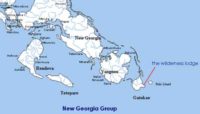 was for decades the stuff of legend. It wasn’t until a logging company (in 2015) accidentally flushed one from hiding, while clearing trees, that the Vika stories changed from fiction to fact. Then in 2017, researchers were able to hunt one of the rats down and through DNA testing found that this huge rodent, was a brand new species.
Now known as Uromys vika , this rat has orangish brown fur, measures a foot an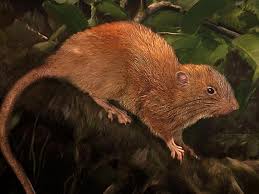 d a half long and weighs more than 2 pounds. To put that in perspective, the average rat in the US., tops out at about 8 ounces with a body 7-11 inches long and tail another 7-9 inches. This new rodent, thought to be strictly herbivorous (plant eating), feasts mainly on nuts whose shells are thicker than that of a coconut. The animal’s massive teeth easily gnaw through the outer layer of the nut to make a meal of its tasty insides.
Another Giant Rat species, the Bosavi woolly rat is one of
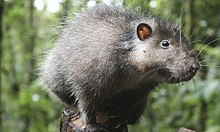
the largest rats, according to the Smithsonian Institution. A Smithsonian biologist discovered this new species of giant rat in 2009 in the crater of Mount Bosavi, an extinct volcano in Papua New Guinea. It weighed close to 3.5 lbs. and measured 32 inches long, including the tail. This gigantic rat has a thick silver-gray coat and was not unafraid of humans. According to researchers, this species may only live inside this volcano.
The African or Gambian pouched rat, Cricetomys gambianus, (is also on the exremely large side. It weighs between 2 to 3 pounds and grows to around 3 feet long (including its’ tail). In its native Africa, the pouched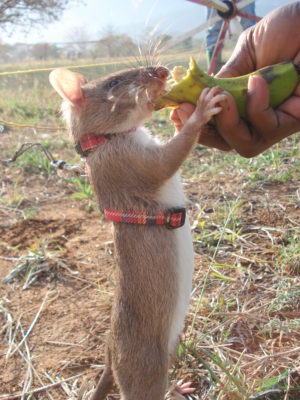 rat lives in colonies of up to twenty, usually in forests and scrub areas, but also very often around termite mounds. It is omnivorous, preferring palm fruits and palm kernels while also feeding on vegetables, insects, crabs, and snails. It is not a true rat but is part of an African branch of muroid rodents. It derives its name from the pouches inside its mouth (in the cheeks) that are used to store extra food.
For all it’s scary and perceived nastiness this rat rates right up there  with the famous “Master Splinter” of Ninja Turtle fame for his save the world attitude. Known universally as the “Hero Rat” for its work as a trained landmine detector and in the medical field for its ablity to detect Tuberculosis.. A single Hero rat can clear 200 square feet of landmine infested g round in an hour (done manually, the same area would take 50 hours to clear). A TB-detection rat can evaluate 50 samples in eight minutes (almost a day’s work for a lab technician).
Since 2000, these rats have cleared mine fields in Tanzania, and detected 6,693 land mines, 26,934 small arms and ammunitions, and 1,087 bombs across hundreds of miles in Mozambique. They’re also hard at work in Thailand, Angola, Vietnam, Cambodia and Laos.
Since 2002, trained tuberculosis-detecting rats have b een used in 19 TB clinics in the Tanzanian city of Dar es Salaam. They’ve successfully screened 226,931 samples and identified 5,594 TB patients. Get more info on these amazing Heros and the innovative research company (Ngo Apopo) that trains and provides their services at https://www.apopo.org/en/. You can even adopt a rat!
Being intelligent, playful and very affectionate, they are sometimes kept as exotic pets. Unfortunately, when a group of Gambian pouched rats escaped fro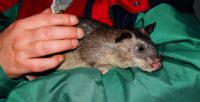 m a breeder in Florida and colonized an island called Grassy Key, they become an invasive species. In addition, in 2003 they played a role in an outbreak of monkeypox in the United States. They are now a restricted animal and can only be imported for scientific research, exhibition, or educational purposes with a valid permit issued by the CDC.
Featured Picture: Giant Gambian Pouched Rat finds a landmine (photo by Xavier Rossi).
Other pictures: From Wikimedia Commons
0 Comments