

 800-901-1102
Controlling the minds of other living creatures is science fiction or at best the stuff of horror stories, right? Well for some, becoming a real live zombie is a deadly reality. In the race for survival, mind control has become something of a specialty for some creatures in the wild and even your own backyard.
Ants: Feasting on the slime of a snail turns ants into mindless zombies.
The Lancet liver fluke (Dicrocoelium dendriticum), forces its’ ant host to attach itself to the tips of grass blades, the easier to be eaten by grazing animals. The fluke needs to get into the gut of a grazing
animal to complete its life cycle. As an adult, the lancet liver fluke—a type of flatworm—r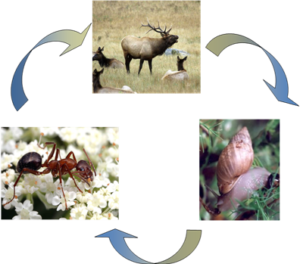 esides in the livers of grazing mammals such as cows. Its eggs are excreted in the host’s feces, which are then eaten by snails. After the eggs hatch inside the snail, the snail creates protective cysts around the parasites and coughs them up in balls of mucus. Real Slime Balls.
These fluke-filled slime balls are consumed by ants. When the flukes wiggle their way into an ant’s brain, they cause the insect to climb to 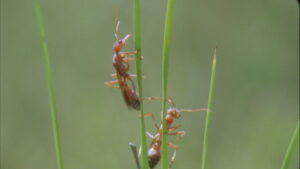 the tip of a blade of grass and sit motionless, where it’s most likely to be eaten by a grazing mammal. That way, the liver fluke can complete its life cycle. Due to the highly specific nature of this parasite’s life cycle, human infections are generally rare.
Rats and Mice: Parasite blocks fear of cats in rats and mice!
Oxoplasma gondii is a protozoan parasite whose life cycle can only be completed in the body of a cat. Rats can carry it, but it needs a cat to survive. And the way it finds a host is ingenious – rats who become infected suffer a change in their brain chemistry which causes them to become attracted to, rather than fearful of the scent of cats.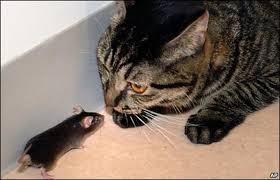 It also makes them attracted to the scent of cat urine and fur and there is evidence that infected male rats are more sexually attractive to females, transmitting the parasite sexually. Obviously, these rats don’t live long lives. Humans can also contract toxoplasmosis – some estimates indicate 1/3 of the world’s population has it. Occasionally fatal, it is particularly dangerous for people with weakened immune systems and pregnant women (which is why women are told to avoid cat litter boxes when they are expecting). Toxoplasmosis has also been linked to many other ailments, including schizophrenia.
Crickets and Grasshoppers: Non-swimmers dive to their deaths.
Horsehair worms (Paragordius tricuspidatus) live inside grasshoppers and crickets, sabotage their central nervous system, and force them to jump into pools of water, drowning themselves. Hairworms then swim away from their hapless hosts to continue their life cycle. First, a tiny horsehair worm larva is eaten by the larva of another insect, such as a mosquito or mayfly. Once this emerges from the water, a cricket or grasshopper will snatch it up. Then the horsehair worm begins to rapidly develop inside its host.
By altering the functions of the cricket’s or grasshopper’s central nervous system, the worm makes it jump right into the nearest body of water. The unfortunate cricket then drowns itself, allowing the horsehair worm to emerge and reproduce. Researchers have noticed as many as 32 worms emerging from one host cricket. From the outside, you can’t tell if a cricket or grasshopper has been infected, but neurologically, the worm is in control.
Fish: Dance to their Death.
The fluke (Euhaplorchis californiensis) is common in Southern California and Baja California estuaries. Its’ life begins in an ocean-dwelling horn snail, where it produces larvae that then seek their next host, a killifish. (See “The Puppet Master’s Medicine Chest.”) Once it finds a fish, the parasite latches on to its gills and makes its way into the brain. But it doesn’t stop there. The fluke needs to get inside the gut of a water bird in order to reproduce. So inside the killifish’s brain, the fluke releases chemicals that cause the fish to shimmy, jerk, and jump, attracting the attention of hungry waterfowl. Researchers, at the University of California, Santa Barbara, found that the parasite decreases serotonin and increases dopamine levels in the fish’s brain. The change in brain chemistry causes fish to swim and behave
 more erratically. These frantic movements are intended to attract the attention of birds, which eat the fluke-infested fish. The flukes mate inside the bird, and their eggs are released back into the water in the bird’s droppings to be eaten by horn snails starting the cycle all over again.
Facts we wish were fiction. More Mind Control Stories.
http://www.bbc.com/earth/story/20150316-ten-parasites-that-control-minds
http://listverse.com/2009/07/29/10-fascinating-cases-of-mind-control/
0 Comments