

 800-901-1102
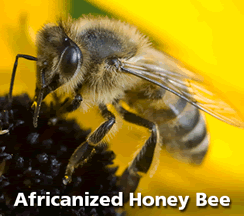 In a U C San Diego study on the Africanized bees’ population growth in Southern California, it was found that more than 60 percent of foraging honeybees in San Diego County are now Africanized.
News Flash — Africanized honeybees, known as killer bees, have made their way to the Bay Area for the first time. Recent warmer weather conditions may have encouraged the move.
Africanized honey bees (AHB) also called Africanized bees or killer bees are descendants of southern African bees imported in 1956 by Brazilian scientists. These scientists were attempting to breed a better, more productive honey bee, better adapted to the South American tropics. This expirament went terribly wrong. Th e bees got away from their handlers and flew, north to find better, more abundant food sources and harborage areas.
Africanized colonies were first reported in Arizona and New Mexico in 1993 and in California in October, 1994. Within a year, more than 8,000 square miles of Imperial, Riverside and northeastern San Diego counties were declared officially colonized by Africanized bees.
These bees are considered a health threat. Experts say that bees overall kill about 40 people a year in the U.S.. No seperate statistics are kept for Africanized bees.People and animals are the most at risk if they don’t have a way to escape an attack. The Africanized bees have killed animals on chains and in fenced enclosures in Southern California and Texas. Last month, a swarm of Africanized bees killed a construction worker and injured two others in Riverside as the workers graded land for a parking lot unaware of the presence of a hive.
Africanized Honey Bee Facts
- They are slightly smaller than the European honey bee, but only an expert can tell them apart
- Defend their hive more rapidly than the European honey bee
- Usually attack and sting in greater numbers
- Are less selective about where they nest
- Swarm more often than European honey bees
- Do not have stronger venom than the European honey bee
- Eat nectar and pollen and make honey
- Are not native to the U.S.; they came from Africa via South America.
Not totally the “bad guys” that they are hyped up to be.
African Honeybees may be the answer to the demise of European bee colonies caused by diseases, mites, fungus and colony collapse disorder. So despite all their negative factors, it is possible that, Africanized honey bees might actually end up saving our agricultural industry and the honey industry too.
0 Comments