

 800-901-1102
You walk outside in the morning and find a wide web stretched across the path to your patio. Later, you lift a planter and spot a dark spider tucked into the cool space underneath. By evening, another one has crossed the garage floor and disappeared behind a storage bin. Several common spiders in California become much easier to notice during fall.
The reason depends on the spider. Orb weavers are larger and build conspicuous webs. Some males wander farther while looking for mates. Widows stay close to protected hiding places around patios, garages, fences, and storage areas. Knowing these common spiders in California helps you identify what is around your home, understand why you are seeing more spiders in fall, and decide when a sighting deserves extra caution.
Why Common Spiders in California Stand Out in Fall
The common spiders in California do not all follow one seasonal pattern. Southern California often stays warm well into October and November, so spiders can remain active outdoors while insects are still available. Irrigated yards, ornamental shrubs, exterior lighting, and sheltered patios give many species suitable places to hunt and hide.
Maturity changes what homeowners notice. A spider that was easy to miss earlier in the year may be fully grown by fall. Orb weavers are especially obvious because their circular webs can stretch between shrubs, fences, railings, eaves, or even across a walkway overnight.
Movement also increases for some species. Male spiders may leave protected areas while searching for females, which is why you can suddenly see a large spider crossing a driveway or garage floor. That does not necessarily mean it has established itself inside the house.
Exterior lighting creates another hotspot. Moths, flies, and other small insects gather around porch lights and windows after dark. Spiders often settle close to those feeding areas, which can make the informal spider season in California feel much busier around patios and entryways.
Common Spiders in California Homes and Yards
The common spiders in California that homeowners notice include web builders, ground hunters, and small active hunters. Some are easy to recognize by the web first. Others are noticed only when they move across an open surface.
| Spider | What Usually Gets Your Attention | Where It Commonly Turns Up |
| Western black widow | Glossy black female, irregular web, red hourglass underneath | Garages, sheds, patio furniture, stored items, woodpiles |
| Brown widow | Brown patterned body and spiky egg sacs | Eaves, fences, planters, railings, outdoor furniture |
| Orb weaver | Large circular web, sometimes with a bulky spider in the center | Shrubs, trees, patios, fences, walkways |
| Wolf spider | Fast movement across the ground | Garages, mulch, garden beds, driveways |
| Jumping spider | Compact body, large front-facing eyes, short bursts of movement | Walls, windows, railings, plants |
| Cellar spider | Small body with very long, thin legs | Garage corners, sheds, ceilings, storage rooms |
Western Black Widows
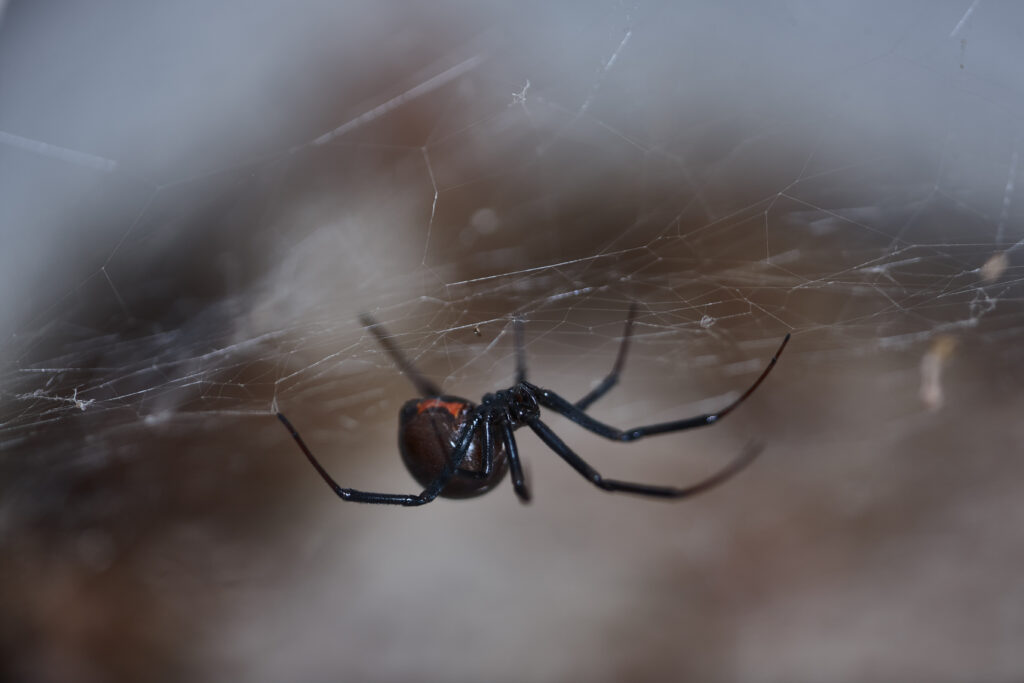
Western black widows are among the few Southern California spiders that deserve extra care around homes. Adult females have a glossy black body and a red hourglass marking on the underside of the abdomen. Their webs look tangled and irregular rather than neatly circular.
The UC Statewide Integrated Pest Management Program reports that an adult female black widow has a body about one-half inch long and may measure roughly 1.5 inches across with the legs extended. They favor places that stay quiet, such as woodpiles, storage areas, the undersides of patio furniture, and corners inside sheds or garages.
Brown Widows
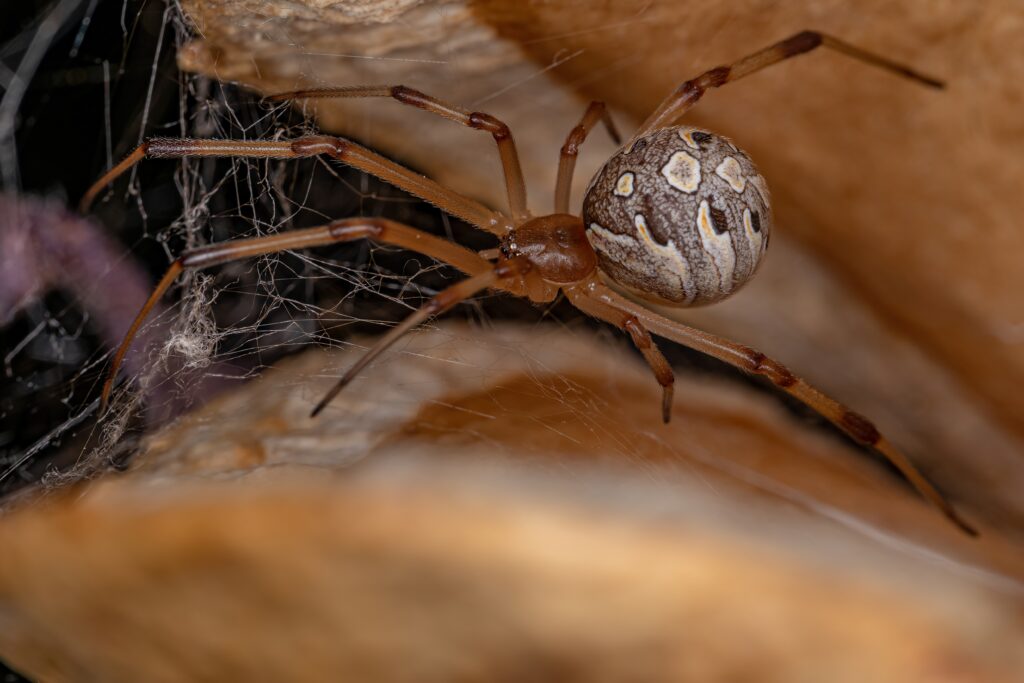
Brown widows can range from light tan to darker brown, so body color is not enough for a confident identification. Their egg sacs are more distinctive because the surface looks spiky or tufted instead of smooth.
Around Southern California homes, brown widows may settle beneath outdoor furniture, along fences, around eaves, inside planters, and near railings. Those sheltered spaces often remain undisturbed for weeks, which gives the spiders time to establish webs and egg sacs.
Orb Weavers
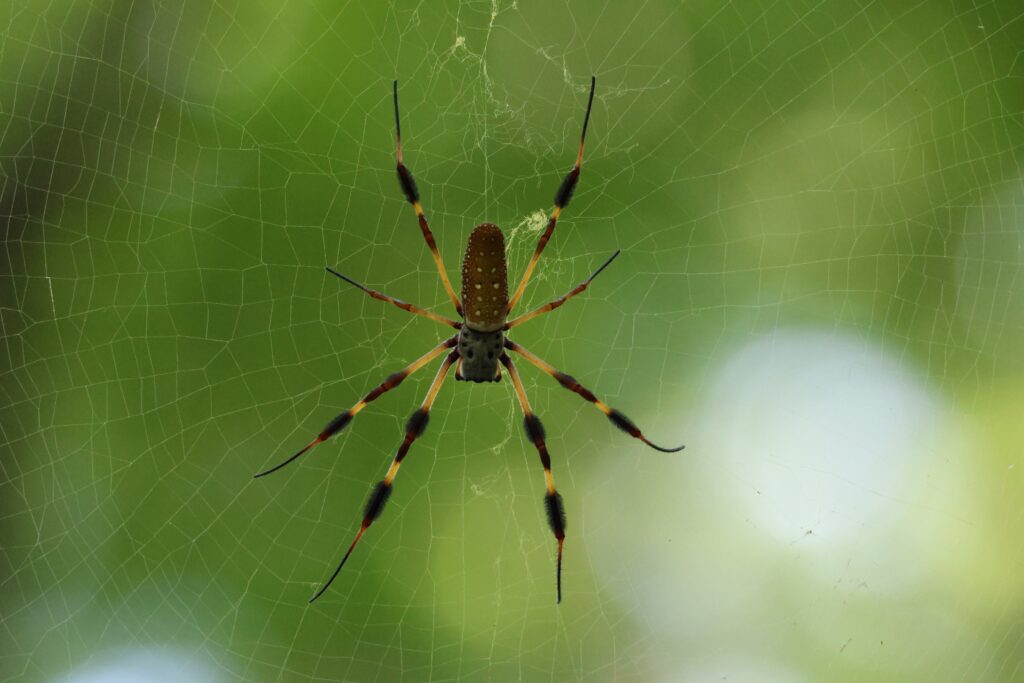
Orb weavers create the large, wheel-shaped webs that become especially noticeable in fall. A mature web may stretch between two shrubs, fill the space beside a fence, or appear across a garden path overnight.
These spiders can look large, but size alone tells you very little about medical risk. Orb weavers are garden spiders that use those webs to catch flying insects around landscaping and exterior lights.
Wolf, Jumping, and Cellar Spiders
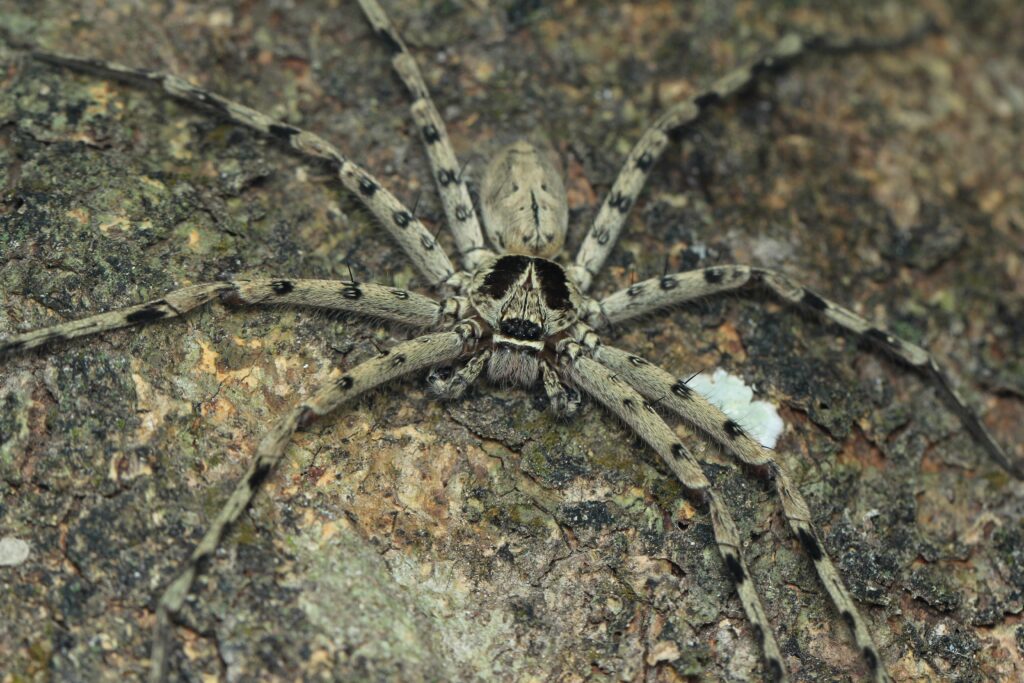
Wolf spiders hunt without relying on a prey-catching web. They move quickly along the ground, so one may suddenly appear on a patio, driveway, garden bed, or garage floor and disappear just as fast.
Jumping spiders are compact hunters with prominent forward-facing eyes. They often turn toward movement and stalk insects on sunny walls, windows, plants, and fences.
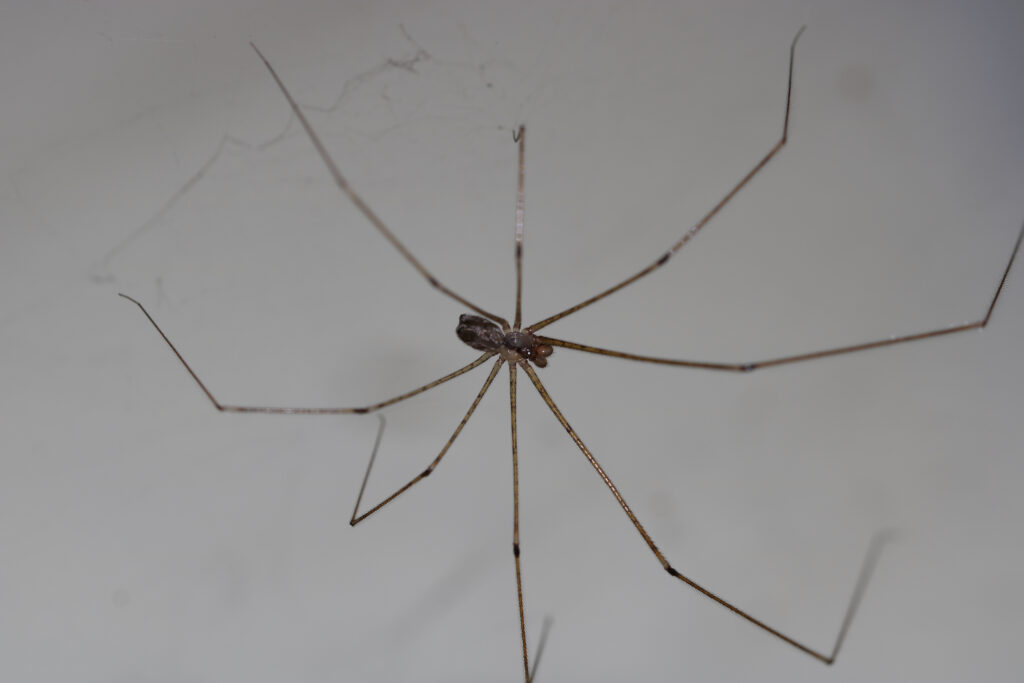
Cellar spiders prefer quieter indoor spaces. Their very long, thin legs make them a familiar sight in garages, storage rooms, ceiling corners, and sheds. Together, these species account for many of the common house spiders in California that homeowners encounter without realizing how different their habits are.
How to Identify Spiders Around Your Home
Good spider identification starts with behavior and location rather than color. Many unrelated spiders are brown, gray, or dark enough to appear black in poor light. Web style, hiding place, and movement usually give you better clues.
A circular web between plants points toward an orb weaver. A loose, irregular web in a sheltered corner can fit a widow or another cobweb spider. A fast-moving spider crossing mulch or concrete without a prey-catching web is more consistent with a ground hunter such as a wolf spider.
| Identification Clue | What It Can Tell You |
| Circular web | Often points toward an orb weaver |
| Loose, irregular web | Common among widows and other cobweb spiders |
| No prey-catching web | May indicate an active hunter |
| Spiky egg sac | Strong clue for a brown widow |
| Red hourglass underneath | Key marking on an adult female black widow |
| Fast ground movement | Common behavior for wolf spiders |
| Large forward-facing eyes | Characteristic of jumping spiders |
Where you find the spider adds context. One sitting beneath an outdoor chair has different likely candidates from one resting in the middle of a garden web. If you want help identifying it, take a clear photo from a safe distance that shows the whole spider and, if possible, the web or hiding place.
Which California Spiders Require Extra Caution?
When people search for dangerous spiders in California or venomous spiders in California, the western black widow is the species that deserves the most attention around homes. It usually stays close to a protected web rather than moving toward people. Bites are more likely when someone reaches into its hiding place or presses the spider against the skin.
That is why simple habits matter around garages, sheds, patios, and storage areas. Wear gloves before moving old boxes, wood, gardening materials, or outdoor furniture that has been left untouched. Look into hidden spaces before putting your hands there.
A skin reaction should not automatically be labeled a spider bite just because a spider was nearby. Other bites, infections, and medical conditions can create similar symptoms. Significant pain, muscle cramping, breathing difficulty, or rapidly worsening symptoms after suspected spider bites warrant medical attention.
Are Brown Recluse Spiders Common in California?
Brown recluse spiders have a much larger reputation in California than their actual distribution supports. A brown spider found in a garage, bedroom, or storage room is often given that name even when the identification does not fit.
UC Riverside’s research explains that the brown recluse is not broadly established as a common household spider across California. Wolf spiders, funnel weavers, house spiders, and several other local species can all be brown.
Related recluse spiders can occur in desert areas of the Southwest, so it would also be inaccurate to say that every recluse-type spider is absent from the state. For most Southern California homeowners, the useful rule is simple: do not identify a spider as a brown recluse based on color alone.
Where Southern California Spiders Find Shelter in Fall
Many Southern California spiders stay where shelter and food overlap. Patios, garages, block walls, irrigated landscaping, and exterior lights provide that combination in different ways.
| Area | Why It Works for Spiders | What to Inspect |
| Patio furniture | Dark undersides remain protected | Frames, covers, stacked chairs, cushion storage |
| Garage | Entry gaps meet long-term storage | Door edges, shelving, boxes, equipment |
| Exterior lights | Insects gather nearby after dark | Fixtures, eaves, walls, nearby windows |
| Shrubs and groundcover | Plants support webs and insect prey | Dense growth, branches touching the house |
| Sheds | Quiet storage creates stable shelter | Gloves, tools, tarps, boxes |
| Block walls and fences | Cracks and joints provide retreats | Wall caps, posts, corners, utility areas |
Garages give spiders both access and cover. A worn door seal can admit insects and spiders, while stacked boxes, sporting equipment, holiday decorations, and tools create hiding places that may not be disturbed for months.
Patios offer many of the same conditions on a smaller scale. Furniture frames, planter rims, grill covers, storage benches, and wall edges provide sheltered surfaces close to outdoor insect activity.
Landscaping can bring both hunting spiders and web builders close to the structure. Shrubs touching siding or eaves provide support and a route toward the house. Keeping plants trimmed back also makes fresh webs easier to spot.
Keeping Fall Spider Activity Under Control in Southern California
Effective spider prevention starts with shelter, access, and prey. Remove old webs from frequently used areas such as entrances, patios, garage openings, eaves, and exterior fixtures. Once old silk is gone, fresh activity becomes easier to notice.
Then look at items that sit untouched. Cardboard boxes, stacked pots, firewood, tarps, patio cushions, and unused equipment all create protected hiding places. Repair torn screens, replace worn weather stripping, and check gaps around garage doors and utility openings so spiders and the insects they hunt have fewer ways inside.
Recurring spiders can also signal steady insect activity nearby. A porch light covered with moths, dense landscaping full of small insects, or a garage that regularly attracts pests gives spiders a reason to stay. Good spider control addresses those conditions instead of reacting to each web one at a time.
Corky’s Pest Control offers spider control services in Southern California. If spiders keep returning around your garage, patio, entryways, or outdoor living areas, a professional inspection can help identify the species, find the conditions supporting the activity, and determine where pest control will make the biggest difference. Contact Corky’s Pest Control to schedule an inspection and get a plan built around your property.
0 Comments